Why Hard Work Alone Stops Working
Many people train consistently.
They show up, sweat, and push themselves.
Yet after a few weeks or months, progress slows. Strength stalls. Fat loss plateaus. Motivation drops.
This isn’t because effort is missing.
It’s because progress requires direction.
That direction is called progressive overload.
What Progressive Overload Actually Means
Progressive overload is not about lifting heavier weights every week.
At its core, it means this:
Your body adapts when it is challenged slightly more than before.
That challenge can come from:
-
Increasing resistance
-
Improving form or control
-
Adding reps or sets
-
Reducing rest time
-
Increasing training consistency
Progress happens when the challenge increases gradually and intentionally, not randomly.
Why the Body Stops Responding Without It
The human body is efficient.
When it repeats the same workload, it adapts and then stabilises. Once adaptation is complete, the stimulus no longer creates change.
This is why doing the same workout with the same weights eventually feels easier but delivers fewer results.
Without progressive overload, workouts maintain fitness but stop building it.
Progressive Overload Is About Planning, Not Pushing
One common misunderstanding is that progressive overload means constant intensity.
In reality, effective overload is planned, not forced.
Some weeks focus on improving movement quality.
Some weeks focus on small increases in load.
Some weeks prioritise recovery while maintaining volume.
This balance allows progress to continue without burnout or injury.
Why Random Workouts Slow Progress
Random workouts feel productive because they are tiring.
But fatigue does not equal progress.
Without a clear progression strategy, the body receives mixed signals. Some muscles are overstressed. Others are undertrained. Progress becomes inconsistent.
Structured training ensures that overload is applied where it matters, when it matters.
How Progressive Overload Supports Fat Loss and Strength
Progressive overload improves:
-
Muscle retention during fat loss
-
Metabolic efficiency
-
Long-term strength gains
-
Training confidence
As strength increases, the body becomes better at using energy efficiently. This supports healthier body composition rather than short-term weight changes.
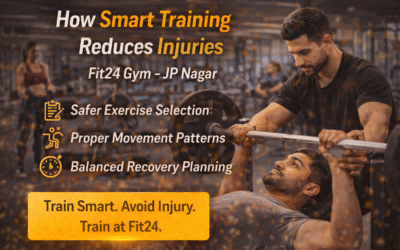
Why Progressive Overload Reduces Injury Risk
Pushing without progression often leads to poor form and joint strain.
Progressive overload prioritises:
-
Technique before load
-
Control before intensity
-
Consistency before extremes
This reduces injury risk and allows training to continue uninterrupted.
Sustainable progress always outperforms aggressive progress.
The Role of Environment and Guidance
Applying progressive overload correctly requires clarity.
Clear programming, appropriate equipment, and a focused environment make progression easier to track and safer to execute.
At Fit24, training systems are designed to apply progressive overload in a structured way, so members progress steadily without guesswork or pressure.
Progress Comes From Direction, Not Exhaustion
Progressive overload explains why effort alone is not enough.
When training has direction, the body adapts predictably. Strength improves. Fat loss becomes sustainable. Confidence grows.
Progress is not accidental.
It is designed.
Want Your Training to Actually Progress?
A structured approach ensures effort leads to results.
Train in a Better Environment
Fat loss works differently from weight loss.
Structure helps you focus on progress that actually lasts.